
The Earth’s crust is in a state of perpetual, though often imperceptible, motion. For millennia, humanity has viewed earthquakes as a purely natural and unpredictable force of a planet in geological flux. However, scientific evidence is revealing a new and alarming truth: human activity is increasingly becoming a trigger for seismic events. The devastating earthquake and tremors are not isolated incidents, but rather stark examples of a shared and burgeoning phenomenon known as induced seismicity.
The concept of induced seismicity posits that human actions, by altering the stress and strain within the Earth’s crust, can trigger or accelerate seismic activity.
The catastrophic earthquake that struck Morocco’s High Atlas Mountains in September 2023 serves as a sobering case study. Beneath these rugged peaks lies a crucial lifeline for the region: a network of aquifers.
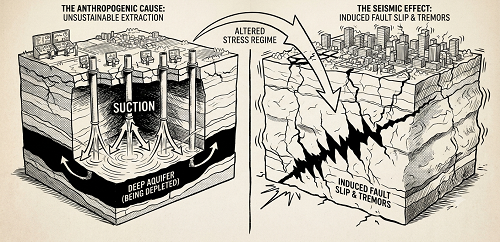
For years, unsustainable groundwater extraction for agricultural and municipal usage had dramatically depleted these underground water reserves. This widespread and persistent removal of water mass subtly, yet significantly, changed the stress on the underlying geological faults. In effect, the loss of this subsurface water pressure removed a stabilizing force, allowing pre-existing tectonic stresses to finally reach a breaking point and release as a devastating earthquake.
A similar, though less dramatic, scenario is unfolding in the Indian capital of Delhi. The city has witnessed an uptick in seismic tremors, a phenomenon that has puzzled many. The most compelling explanation points to the city’s critically declining groundwater levels. Reports from the Central Ground Water Board (CGWB) have consistently highlighted the alarming rate at which the National Capital Region is losing its subterranean water. As vast quantities of water are pumped out, the subsurface becomes less buoyant and the overlying rock mass subsides. This change in stress on the delicate fault lines of the Aravalli-Delhi fold belt, a key geological feature of the region, can act as a catalyst for minor tremors. While not on the scale of the Morocco earthquake, these incidents serve as a grave warning about the potential for future, more powerful seismic events if the current rate of groundwater extraction continues unabated.
While groundwater depletion presents a clear and present danger, it is merely one facet of a multi-dimensional problem. Induced seismicity is a complex phenomenon with a variety of human and climate-related triggers. Climate change, in particular, is altering the Earth’s surface in ways that can directly influence seismic activity. The melting of massive glaciers and ice sheets triggers two distinct, interconnected geological processes:
Isostatic Rebound: During ice ages, the sheer weight of colossal ice sheets causes portions of the Earth’s crust to sink, putting immense pressure on the underlying mantle. As global temperatures rise and glaciers melt, this weight is removed, causing the crust to slowly “rebound” to its original position. This upward movement can trigger dormant faults and cause seismic activity.
Oceanic Loading: Simultaneously, as glaciers melt, the runoff flows into the world’s oceans, increasing the mass of the oceanic water column. This added water mass exerts tremendous pressure on the oceanic crust, particularly along coastlines and subduction zones, destabilizing fault lines and increasing the frequency of coastal and offshore earthquakes.
Beyond climate shifts, direct engineering projects also play a major role. Another well-documented cause of induced seismicity is the filling of large artificial reservoirs. When a mega-dam is constructed, the sheer weight of billions of tons of water in the newly created lake significantly alters the stress on the underlying rock. Furthermore, the water seeps into the ground, increasing fluid pressure within geological faults. This fluid acts as a lubricant, reducing the friction that holds the fault in place and allowing it to slip more easily.
Similarly, promising climate solutions like carbon capture and storage (CCS)—where captured carbon dioxide is injected into deep geological formations—carry a seismic risk. The high-pressure injection can cause a buildup of stress and fluid pressure in the surrounding rock, potentially triggering tremors.
For a nation like India, grappling with a burgeoning population and a vast landmass, the threat of induced seismicity is particularly acute. The Bureau of Indian Standards (BIS) has classified roughly 59% of the country’s land as vulnerable to earthquakes. The Himalayan region, which falls under Seismic Zone V (the highest risk category), is a testament to the massive tectonic forces at play as the Indian subcontinent continues its inexorable collision with the Eurasian plate. Despite this inherent geological fragility, deep and extensive construction can significantly alter the crustal dynamics of the already sensitive region, potentially creating new stress points or reactivating existing faults.
The growing threat of induced seismicity demands an urgent reassessment of our relationship with the planet. The problem is twofold: not only triggering more frequent seismic events, but also a glaring lack of preparedness in vulnerable regions, amplifies the threat. The country faces a significant deficit in earthquake-resistant construction and a general lack of community-level readiness.
Addressing this issue requires a fundamental shift in our approach to the development model and climate policy. All major infrastructure projects, especially in seismically active areas, must undergo rigorous geological and seismic risk assessments that account for induced seismicity. Governments must implement and enforce policies that promote sustainable water management, responsible resource extraction, and safe carbon capture technologies to minimize their impact on geological stability. Additionally, building codes must be strictly enforced, and public awareness campaigns on earthquake preparedness—from safe building practices to evacuation drills—must be prioritized.
As we continue to develop and innovate, we must do so with a deeper respect for the Earth’s delicate geological balance, or we may find that the ground beneath our feet is far less stable than what we imagine.
……………………………………………………………………………………………………………………………………………….
Source
- https://www.sciencedirect.com/science/article/pii/S001282521730003X#:~:text=It%20is%20thus%20unsurprising%20that,induced%20seismicity%20reported%20to%20date.
- https://www.preventionweb.net/news/groundwater-depletion-may-have-been-significant-trigger-2023-morocco-earthquake#:~:text=The%20most%20affected%20areas%20saw,in%20slowly%20deforming%20mountain%20belts.
- https://www.seismosoc.org/news/groundwater-depletion-may-have-been-significant-trigger-for-2023-morocco-earthquake/#:~:text=24%20December%202024–The%20rapid,the%20Seismological%20Society%20of%20America.
- https://cgwb.gov.in/cgwbpnm/public/uploads/documents/17357169591419696804file.pdf
- https://link.springer.com/chapter/10.1007/978-3-030-64308-9_4#:~:text=Abstract,induced%20earthquakes%20in%20the%20future.
- https://www.sciencedirect.com/science/article/pii/S001282521730003X#:~:text=Activities%20that%20have%20been%20proposed,explosions%20doing%20so%20is%20weak.
- https://oceanservice.noaa.gov/facts/glacial-adjustment.html
- https://ikcest-drr.data.ac.cn/post/1d67b#:~:text=Abstract,assessment%20in%20glacier-covered%20ranges.
- https://www.sciencedirect.com/topics/earth-and-planetary-sciences/reservoir-induced-seismicity
- https://www.sciencedirect.com/science/article/abs/pii/S0012825223000582
- https://www.pib.gov.in/PressNoteDetails.aspx?NoteId=154005&ModuleId=3#:~:text=Approximately%2059%25%20of%20India%20is,II%20is%20the%20least%20affected
- https://www.researchgate.net/publication/266868176_Seismic_Vulnerability_in_the_Himalayan_Region
- https://ndma.gov.in/sites/default/files/PDF/Guidelines/Simplified_Guidelines_for_earthquake.pdf