
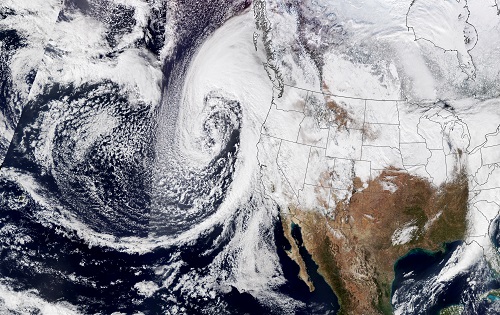
“A flying river? It might sound like science fiction, but this remarkable atmospheric phenomenon is real. It is not a mythical or fabled place. We are talking about atmospheric river or otherwise called “flying river.” It is a long, narrow band of concentrated moisture that transports water vapour from the lower part of the atmosphere – tropics to the cooler latitudes.
It is a meteorological phenomenon responsible for nourishing the global water cycle, and a strong reason for torrential flooding across geographies. Whenever an atmospheric river makes its landfall, it releases the moisture they’ve been carrying, resulting in heavy precipitation in the form of rain or snow.
This may sound similar to the rainfall or water cycle process: evaporation, condensation, and ultimately, precipitation. However, atmospheric rivers and the water cycle are two distinct phenomena. The water cycle is a continuous process involving exchange of water between the atmosphere, land, and ocean.
Whereas atmospheric rivers are known to carry large amounts of moisture over long distances to the higher latitudes. It is important to note that the water carried by an atmospheric river (AR) or the water cycle varies significantly: whether in terms of its size or intensity.
These two phenomena are vital for the global water cycle. Precipitation or rain caused by the atmospheric rivers or water cycle will replenish the water bodies and groundwater levels. Moreover, they are known to create snow packs especially in mountainous regions. These snow packs revive water bodies as they melt. Also, these snow packs are also known to reflect back sunlight,which cools off the Earth’s surface. This is called albedo.
Apparently the atmospheric river boasts its features, it is known to unleash destruction and chaos. And today, climate change is exacerbating it. Experts estimate that an atmospheric river can transport water vapour 15 times that of average flow of the Mississippi River.
To understand better, the landfall of an atmospheric river in Kerala was evident for the extreme precipitation, resulting in the infamous 2018 Kerala floods. Evaporation of water is the main source of atmospheric river formation.
As the earth becomes hotter due to global warming, evaporation rates escalate. This eventually led to the formation of longer and intense bands of atmospheric river. Landfall of such an intensive atmospheric river will eventually lead to heavy rains, and lead to catastrophic floods.
Added to that, land soaked by rain will increase and even accelerate the chances of landslides. One article from April 2025 mentions that AccuWeather had forecast the possibility of up to four months’ worth of rain in less than a week for a 1,000-mile-long swath of the Central US because of the atmospheric river.
The atmospheric river is no alien phenomenon to India. Studies indicate that India’s 10 most severe floods in the monsoon seasons between 1985 and 2020 were associated with atmospheric rivers. Increased evaporation rate in the Indian ocean is making the phenomenon stronger and harsher than before. However, preparedness and least research importance resulted in chaotic flash floods and human loss.
Atmospheric rivers are naturally occurring processes and vital components of the global climate system. These “rivers in the sky” transport massive amounts of water vapor from the tropics to other parts of the world, often playing a crucial role in replenishing water supplies.
Addressing the challenges of atmospheric rivers requires a shift from a reactive, post-disaster response to a proactive, integrated approach that combines advanced science, resilient infrastructure, and informed community action.
Coping with the challenges of atmospheric rivers requires a strategic, all-encompassing approach. This starts with improved forecasting, using advanced technology to predict storm paths and give communities more time to prepare. It continues with enhancing infrastructure resilience, which includes modernizing dams with smart water management systems and implementing “green” solutions like permeable surfaces and restored floodplains to absorb excess water.
Beyond infrastructure, effective land use planning is crucial, meaning we should limit new construction in flood-prone areas and preserve natural ecosystems that can slow down and soak up floodwaters. Finally, a prepared public is essential, so individuals and communities should have emergency plans ready, and governments must maintain reliable early warning systems to ensure everyone is safe.
Year after year, floods are devastating India in multitude ways. Understanding the cause, and its impact stands crucial for the country to reduce the risks and save its citizens.
…………………………………………………………………………………………………………………………………………………….
Sources
- https://www.climate.gov/news-features/blogs/enso/when-rivers-reach-sky#:~:text=Atmospheric%20rivers%20are%20long%2C%20narrow,millions%20of%20dollars%20(1).
- https://www.noaa.gov/stories/what-are-atmospheric-rivers
- https://www.noaa.gov/stories/what-are-atmospheric-rivers#:~:text=While%20atmospheric%20rivers%20are%20responsible,Last%20update:%20March%202023.
- https://www.usgs.gov/news/featured-story/rivers-sky-6-facts-you-should-know-about-atmospheric-rivers
- https://www.accuweather.com/en/weather-forecasts/atmospheric-river-to-trigger-central-us-flooding-that-may-become-life-threatening-historic/1760941
- https://www.sciencedirect.com/science/article/abs/pii/S0169809521000405
- https://eos.org/research-spotlights/the-escalating-impact-of-global-warming-on-atmospheric-rivers
- https://www.bbc.com/news/articles/cv2g9x47441o
- https://visibleearth.nasa.gov/source/104/api.asmx?page=15&size=large#:~:text=Storms%20Soak%20California,Weather%20Whiplash